

1.9 KiB
Simple Example of FreeRTOS porting on a Custom nRF52 Board
By default, the nRF52 chip is not supported by FreeRTOS. However, since it uses an ARM Cortex-M4, we can manually port FreeRTOS to it.
This repository provides basic examples of porting FreeRTOS to the nRF52 using PlatformIO with the Arduino framework. The FreeRTOS kernel files are located in lib/FreeRTOS/, so we need to add the following build flags and sources to platformio.ini:
build_flags =
  -I lib/FreeRTOS/include
  -I lib/FreeRTOS/portable/GCC/ARM_CM4F
build_src_filter  =
  +<*>
  +<lib/FreeRTOS/*.c>
  +<lib/FreeRTOS/portable/GCC/ARM_CM4F/*.c>
  +<lib/FreeRTOS/portable/MemMang/*.c>
The FreeRTOS kernel used in this example is version 11.0.0.
Examples
-
Simple FreeRTOS for LED Blinking with Two LEDs
This example modifies
FreeRTOSConfig.hto add the following handlers, which connect the MCU to FreeRTOS:#define vPortSVCHandler SVC_Handler#define xPortPendSVHandler PendSV_Handler#define xPortSysTickHandler SysTick_Handler
The SysTick timer uses the CPU's main clock.
-
Simple FreeRTOS with Low-Power Mode and LED Blinking
In this example,
FreeRTOSConfig.his modified to add:#define vPortSVCHandler SVC_Handler#define xPortPendSVHandler PendSV_Handler
The SysTick timer uses the RTC's clock, set with
#define configSYSTICK_CLOCK_HZ (32768UL). Additionally, the default SysTick behavior of the RTOS is overridden inlow_power_config.cpp.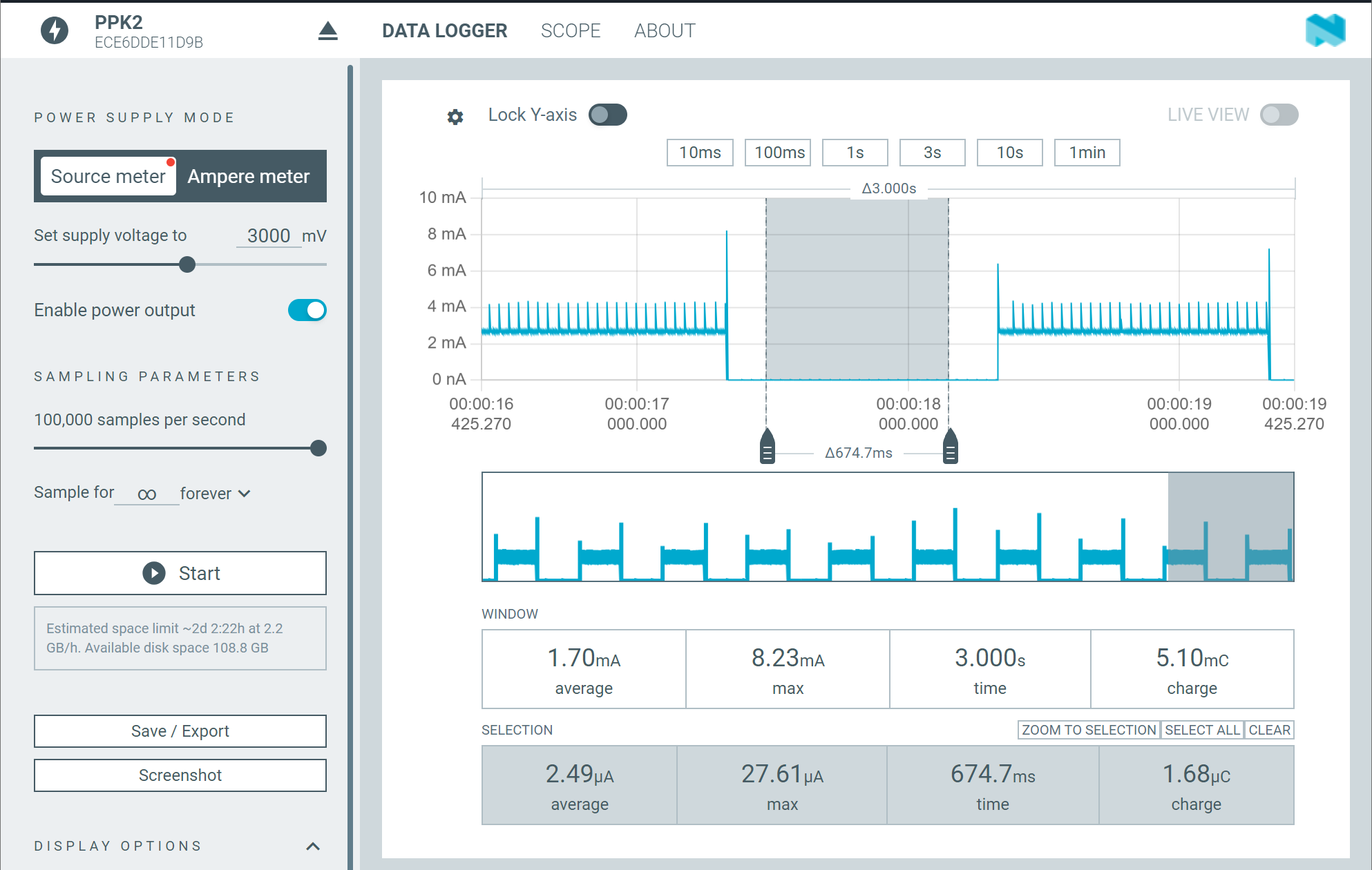
Figure: Power consumption measurement shows ~2.5 µA at 3V when the LED is off.

*Note: In this example, I am using a custom board based on nRF52832. Also, for the programmer, CMSIS-DAP programmer hardware is used (with 4 connections: VCC, GND, DIO, CLK). Adjust its upload_protocol and debug_tool according to your needs.